
Temporal: The Quiet Infrastructure Giant Behind Reliable AI and Distributed Systems Raises $550 Million at a $12.55 Billion Valuation
While much of the technology world's attention remains focused on AI models and applications, a new generation of infrastructure companies is emerging as critical enablers of the AI economy.
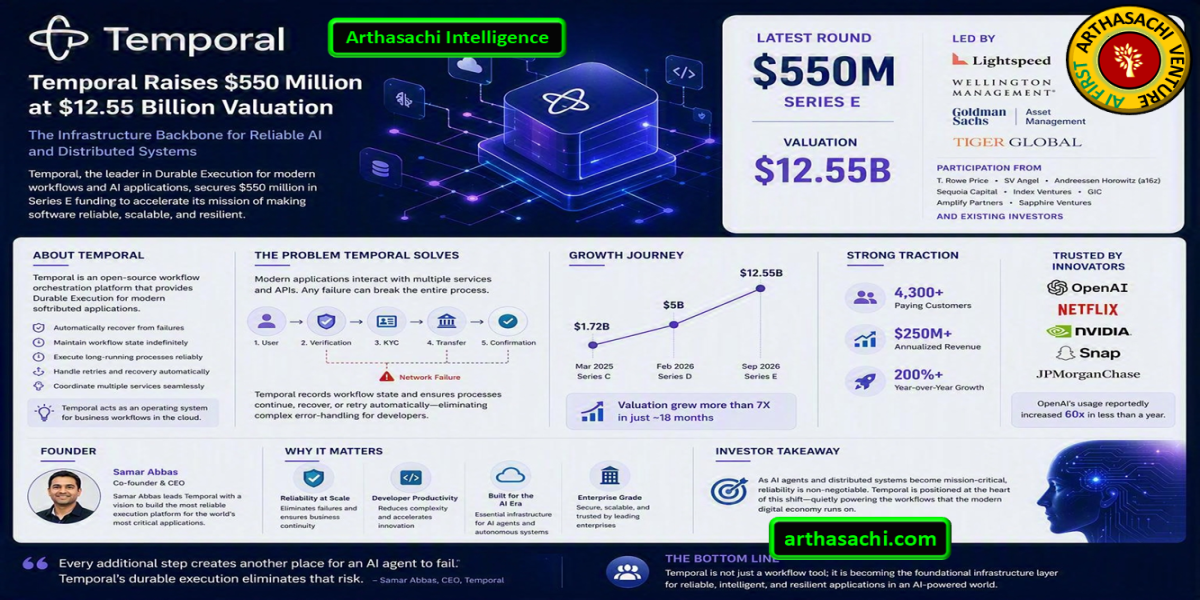
One such company is Temporal, which recently raised $550 million in a Series E funding round at a valuation of $12.55 billion, more than doubling its valuation from just months earlier.
For investors, Temporal represents an interesting case study of how infrastructure companies can become category leaders by solving deep technical problems that affect thousands of enterprises globally.
The Latest Funding Round
Temporal announced a $550 million Series E financing round, valuing the company at $12.55 billion. The round was led by Lightspeed Venture Partners, with Wellington Management, Growth Equity at Goldman Sachs Alternatives, and Tiger Global participating as co-leads.
Additional participants included:
- T. Rowe Price
- SV Angel
- Andreessen Horowitz (a16z)
- Sequoia Capital
- Index Ventures
- GIC
- Amplify Partners
- Sapphire Ventures
Many existing investors increased their positions, demonstrating continued confidence in Temporal's growth trajectory.
A Remarkable Valuation Journey
Temporal's rise has been nothing short of extraordinary.
Key milestones include:
| Year | Round | Valuation |
|---|---|---|
| March 2025 | Series C | $1.72 Billion |
| February 2026 | Series D | $5 Billion |
| September 2026 | Series E | $12.55 Billion |
In roughly 18 months, the company's valuation increased more than sevenfold, reflecting growing demand for reliable workflow orchestration and infrastructure supporting AI agents.
Founders Behind Temporal
Temporal was founded by engineers who had firsthand experience building workflow systems at scale.
The company's CEO is Samar Abbas, who has been instrumental in driving Temporal's product vision and commercial expansion. Under his leadership, the company has positioned itself as a foundational platform for modern distributed applications and AI-powered systems.
The founding team's insight was simple but powerful:
Modern applications fail constantly because distributed systems are inherently unreliable.
Applications today interact with databases, cloud services, APIs, AI services, messaging queues, payment gateways, and hundreds of external systems. Any one of these components can fail, causing business processes to break.
Temporal was built to eliminate that complexity.
What Is Temporal?
Temporal is an open-source workflow orchestration platform that provides what it calls Durable Execution.
At its core, Temporal helps developers build applications that:
- Automatically recover from failures
- Maintain workflow state indefinitely
- Execute long-running processes reliably
- Handle retries and recovery automatically
- Coordinate multiple services seamlessly
Instead of developers writing extensive error-handling and recovery logic, Temporal handles these challenges automatically.
Think of Temporal as an operating system for business workflows running in the cloud.
The Fundamental Problem Temporal Solves
To understand Temporal's value proposition, consider a simple financial transaction:
- User initiates payment.
- Bank verification begins.
- KYC process starts.
- Funds are transferred.
- Confirmation message is sent.
Now imagine the network fails during Step 4.
Traditional systems often require custom code to determine:
- What succeeded?
- What failed?
- What should be retried?
- What data should be recovered?
This becomes exponentially more difficult as systems grow.
Temporal automates this process through Durable Execution. It records workflow state and ensures processes continue, recover, or retry without developers manually handling every failure scenario.
Why AI Has Accelerated Temporal's Growth
The rise of AI agents has significantly expanded Temporal's opportunity.
Modern AI agents:
- Run for extended periods
- Interact with multiple applications
- Execute complex tasks
- Depend on numerous APIs and tools
Each interaction creates potential failure points.
Temporal's infrastructure ensures these agents can continue operating reliably even when some components fail. As CEO Samar Abbas noted, every additional step creates another place for an AI agent to fail. Temporal aims to eliminate that risk through Durable Execution.
This capability has become increasingly valuable as enterprises deploy AI into mission-critical environments.
Impressive Customer Base
Temporal has achieved substantial enterprise adoption.
The company reports:
- More than 4,300 paying customers
- Annualized revenue exceeding $250 million
- More than 200% year-over-year growth [finance.biggo.com]
Customers include some of the world's most sophisticated technology organizations:
- OpenAI
- Netflix
- Nvidia
- Snap
- JPMorgan Chase
Notably, OpenAI's usage reportedly increased sixtyfold in less than a year, highlighting the growing importance of reliable workflow infrastructure in AI operations.
Why Investors Are Excited
Investors are increasingly attracted to infrastructure businesses because they often become deeply embedded into customer operations.
Temporal has several characteristics venture investors love:
Massive Market Opportunity
Every modern enterprise runs distributed applications.
The need for reliability is universal.
Strong Developer Adoption
Temporal's open-source model has helped create a vibrant developer community while driving commercial adoption.
AI Infrastructure Tailwinds
As AI agents become mainstream, reliability becomes even more critical.
High Switching Costs
Once workflows are built on Temporal, migration becomes difficult, creating long-term customer retention advantages.
Lessons for Entrepreneurs and Investors
Temporal's story offers several important lessons:
1. Solve Painful Infrastructure Problems
The company did not build another AI model.
It solved a foundational reliability problem affecting millions of developers.
2. Open Source Can Be a Powerful Distribution Engine
By building an open-source community first, Temporal accelerated adoption and trust.
3. Infrastructure Often Wins Quietly
Most end users have never heard of Temporal.
Yet it powers workflows inside some of the world's largest organizations.
4. AI Creates New Opportunities Beyond Models
The AI revolution is not only about AI applications.
The supporting infrastructure layer may prove equally valuable.
Final Thoughts
Temporal's rise from a startup valued at $1.72 billion in 2025 to a company worth $12.55 billion today demonstrates the immense value created by solving hard infrastructure problems.
In many ways, Temporal is becoming to modern workflows what databases became to applications: a critical backbone that developers depend upon but rarely think about.
As AI agents become more autonomous and enterprises increasingly rely on complex distributed systems, the need for reliability will only grow. Temporal appears well positioned to become one of the foundational infrastructure companies powering this next era of computing.
Investor Takeaway: While AI applications often capture headlines, infrastructure providers like Temporal may ultimately become some of the most valuable beneficiaries of the AI revolution. Their products sit behind the scenes, but they are increasingly becoming indispensable to the digital economy.
Top News



Other News







MARKETS
WEALTH
ECONOMICS
START UP
TECHNOLOGY
BUSINESS
Alliances and Partners

Arthasachi Venture Footprints
Apps
Dowload Our "Arthasachi Venture Wealth" Apps
Apple IOS App

Andriod App