
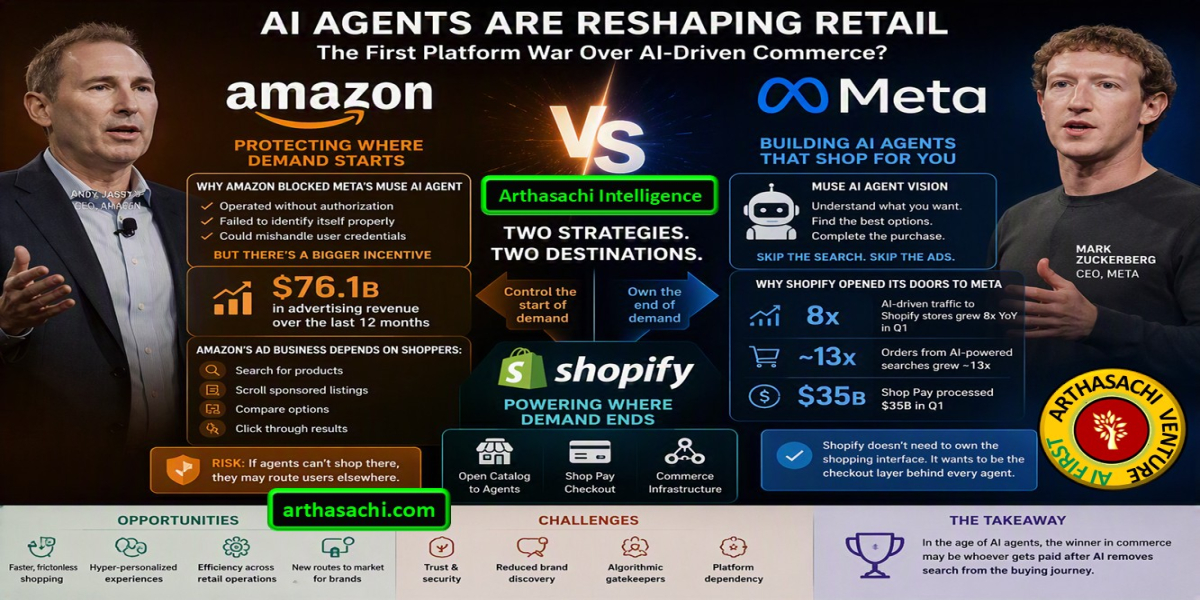
AI Transforming Retail: Opportunities, Challenges, and the New Platform War Between Amazon and Meta
Artificial Intelligence is rapidly transforming the retail and consumer landscape. What began as recommendation engines and personalized advertisements is now evolving into something far more disruptive: autonomous AI agents that can research products, compare prices, make purchasing decisions, and complete transactions on behalf of consumers.
As AI agents become more capable, a fundamental question is emerging: Who will control the future of commerce when consumers no longer browse websites themselves?
The recent clash between Amazon and Meta may represent the first major platform war of the AI agent era.
The Rise of Agentic Commerce
For decades, online shopping has followed a familiar journey. Consumers search for products, compare options, browse reviews, view advertisements, and eventually make a purchase.
AI agents threaten to compress that entire process into a single interaction.
Instead of typing keywords into a search bar and scrolling through pages of results, a customer might simply tell an AI assistant:
"Find the best noise-cancelling headphones under $300 and place the order."
The AI agent would handle research, comparison, selection, and checkout independently.
This shift creates significant opportunities for both consumers and businesses.
Opportunities
1. Faster and Frictionless Shopping
AI agents eliminate many of the repetitive tasks involved in online shopping. Consumers save time while receiving recommendations tailored to their specific needs, budgets, and preferences.
2. Hyper-Personalized Experiences
Unlike traditional search engines, AI agents can understand a consumer's purchase history, brand preferences, lifestyle, and intent. This enables highly personalized product recommendations that improve conversion rates.
3. Greater Efficiency for Retailers
Retailers can use AI to optimize inventory, pricing, promotions, customer service, and supply chain management. AI-powered commerce could significantly reduce marketing waste while improving customer satisfaction.
4. New Routes to Market
Smaller merchants may gain access to customers through AI assistants rather than relying solely on expensive advertising campaigns. If an AI agent recommends products based on value and relevance, niche brands could compete more effectively against established players.
The Challenges of AI-Powered Commerce
While the opportunities are substantial, agentic commerce introduces serious challenges.
1. Trust and Security
AI agents handling shopping transactions require access to sensitive customer information, including payment credentials and personal preferences. Retailers must ensure that agents operate securely and transparently.
2. Loss of Consumer Choice Visibility
Consumers may see fewer options when an agent selects only a handful of products. The risk is that algorithms become gatekeepers, potentially favoring certain brands, products, or ecosystems.
3. Reduced Brand Discovery
Traditional e-commerce platforms are designed around discovery. Sponsored products, recommendations, and browsing behavior help consumers discover new brands. AI agents could bypass much of this experience.
4. Platform Dependency
Retailers may become increasingly dependent on whichever AI platforms consumers trust the most. This creates a new concentration of power around agent providers rather than marketplaces.
Amazon vs. Meta: A Battle for the Future of Commerce
The growing rivalry between Amazon and Meta highlights these strategic tensions.
According to recent reports, Amazon blocked Meta's Muse AI shopping agent from accessing its platform. Amazon cited concerns that the agent operated without authorization, failed to properly identify itself, and could potentially mishandle customer credentials.
These concerns are legitimate. Any autonomous agent interacting with a commerce platform raises important security and compliance questions.
However, there may be a much larger strategic issue beneath the surface.
Amazon generated approximately $76.1 billion in advertising revenue over the last twelve months. That advertising business depends heavily on consumer engagement within Amazon's shopping experience.
Consumers typically:
- Search for products
- Browse listings
- Compare alternatives
- View sponsored placements
- Click through recommendations
These activities create valuable advertising inventory and data signals.
AI agents challenge this model.
If an agent already understands what a consumer wants and can immediately select the best option, much of the search-and-discovery journey disappears. As a result, the opportunities for advertising exposure shrink significantly.
In effect, AI agents threaten to remove one of the most profitable layers of the e-commerce value chain.
Shopify's Different Strategy
While Amazon is seeking to protect its marketplace experience, Shopify appears to be pursuing a different vision.
The company recently opened its catalog and Shop Pay infrastructure to Meta's AI agent ecosystem.
The rationale is clear.
Reports indicate that AI-driven traffic to Shopify merchants increased roughly eightfold year-over-year during the first quarter, while orders originating from AI-powered searches grew approximately thirteenfold. Meanwhile, Shop Pay processed around $35 billion in payment volume during the quarter.
Unlike Amazon, Shopify does not need to own the consumer's shopping journey. Its business benefits primarily from merchant success and transaction volume.
As long as an AI agent ultimately completes purchases through Shopify's infrastructure, Shopify wins regardless of where demand originates.
This reflects two fundamentally different strategies:
Amazon's Strategy: Own the destination where demand begins.
Shopify's Strategy: Become the infrastructure where transactions end.
The Strategic Risk for Amazon
Amazon's position is understandable. The company has spent decades building the world's most successful digital marketplace.
However, there is a potential risk.
If AI agents become consumers' primary shopping interface, platforms that restrict agent access could find themselves increasingly bypassed. Agents may learn to prioritize merchants, marketplaces, and ecosystems that are easier to access and transact with.
Historically, whenever a new interface becomes dominant, power tends to shift toward the platforms that embrace it earliest.
The PC era rewarded software ecosystems.
The mobile era rewarded app ecosystems.
The AI era may reward agent ecosystems.
If that happens, the question will no longer be who owns the marketplace. Instead, it may become who owns the relationship with the AI agent acting on behalf of the consumer.
The First Real Platform War of the AI Age?
The conflict between Amazon and Meta is about far more than a single AI shopping agent.
It represents a deeper battle for control over the next generation of digital commerce.
Meta wants AI agents to become the starting point for consumer purchasing decisions.
Amazon wants to preserve the high-value discovery journey that powers its marketplace and advertising business.
Shopify is positioning itself as the transaction infrastructure that benefits regardless of which interface wins.
As AI increasingly removes search, browsing, and comparison from the purchasing journey, value will shift toward whichever companies control either the consumer relationship or the transaction layer.
The emerging era of agentic commerce may ultimately be defined by a simple question:
When AI makes the buying decision, who gets paid?
That answer could determine the winners and losers of the next decade of retail.
Top News





Other News










MARKETS
WEALTH
ECONOMICS
START UP
TECHNOLOGY
BUSINESS
Alliances and Partners

Arthasachi Venture Footprints

Apps
Dowload Our "Arthasachi Venture Wealth" Apps
Apple IOS App

Andriod App