
END OF AN ERA AT APPLE, TIM COOK’s LAST DAY AS CEO
On August 31, 2026, Tim Cook walked out of Apple Park as its Chief Executive Officer for the final time. After fifteen years in the role; longer than any Apple CEO other than Steve Jobs himself - Cook handed the title to John Ternus, Apple's longtime head of hardware engineering, and moved into the newly created role of Executive Chairman. It is, by any measure, the end of an era. It is also the quiet close of one of the most consequential runs in the history of American business. Our partnership with Apple through Arthasachi Venture Partners has been a privilege. The experience has been truly remarkable and a firsthand lesion in world-class innovation and leadership.
The Numbers Tell Their Own Story
When Tim Cook took over from Steve Jobs on August 24, 2011, Apple was worth roughly $350 billion. Steve left Apple with a powerful legacy of innovation, design excellence, along with some of remarkable products and ecosystem to expand and capture the Global Markets - iPhone, iPad, Mac and a vision to "think different. By his last trading day as CEO, Apple's market capitalization stood at approximately $4.585 trillion, second in the world only to Nvidia. That is a thirteen-fold increase, and it means Cook's tenure created something on the order of $4.2 trillion in shareholder value — a sum that exceeds the entire stock market capitalization of the United Kingdom and would rank among the five or six largest national stock markets on earth if it stood on its own.
Appe’s stock rose by more than 2,000% during Tim Cook’s tenure, vastly outperforming the S&P 500's roughly 500% gain across the same stretch. Annual revenue nearly quadrupled, from about $108 billion in 2011 to $416 billion in 2025. iPhone revenue alone grew from $47.1 billion to $209.6 billion - a single product line now generating more revenue each year than most Fortune 500 companies generate in total. Cook didn't just preserve what Jobs built. He scaled it to a size nobody, including perhaps Cook himself, expected it could reach. I feel fortunate to have ridden part of this remarkable journey through my investment in Apple stock.
“Steve Jobs created the vision and revolutionized consumer technology, while Tim Cook transformed that vision into a globally scaled, highly profitable ecosystem that continued Apple's growth long after Jobs' passing.”
Few leaders in corporate history have been handed a company already carrying the weight of a cultural icon and then managed to make it larger, more profitable, and more deeply embedded in daily life for a population approaching a billion active devices strong. That is Cook's real achievement: not a single product or moment, but fifteen years of compounding execution.
A Legacy Built at Scale
The specifics of that legacy are worth naming individually, because together they explain why Apple in 2026 looks nothing like the company Cook inherited, build by Steve Jobs.
The iPhone remains the center of gravity. More than a decade after critics first warned that Apple was “just a hardware company riding one product,” the iPhone still commands the high end of the global smartphone market and continues to generate the cash that funds everything else Apple does - from R&D to buybacks to its expanding services empire.
Apple Silicon was arguably Cook's boldest bet, and it paid off. The move away from Intel processors and onto Apple's own M-series chips didn't just improve battery life and performance - it gave Apple full control of its hardware-software stack at exactly the moment that control became strategically vital. That same silicon roadmap is now the foundation of Apple's push into on-device AI, an area where the company arrived later than its rivals but is leaning on its chip advantage to compete on its own terms.
Services quietly became the company's second engine. What began as an accessory business - iTunes, the App Store, iCloud - has grown into a segment generating more than $100 billion a year, a high-margin, recurring-revenue business that gives Apple a financial profile closer to a software company than a hardware manufacturer.
The Apple Watch and AirPods, both launched on Cook's watch, did something Apple hadn't done in years before that: they created entirely new product categories and then came to dominate them, turning wearables into a business larger than most standalone technology companies.
The Mac's position also shifted in a way that's easy to underappreciate. It went from a niche creative-professional machine to a fixture in corporate boardrooms, a default choice for senior executives, and — helped by Apple Silicon's efficiency and battery life — a favorite of Gen Z professionals and first-time entrepreneurs building companies from laptops rather than server rooms. And with the Mac mini and Mac Studio, Apple has been quietly repositioning the Mac again: as a compact, powerful, and private local hub for running AI workloads at home or in small offices, entirely under the user's control and off the cloud, at a moment when data privacy and control over one's own compute have become selling points in their own right.
None of these individually would define an era. Together, they describe a company that diversified far beyond the product it's still best known for, without ever losing its grip on that product.
The Shoes He Had to Fill
To understand what Cook accomplished, it helps to remember what he inherited - Steve Jobs created the world class products iPhone, iPad, Mac, along with strong vision and Jobs revolutionized consumer technology. Jobs was the visionary: the product intuition, the theatrical keynotes, the singular taste that decided what Apple would and would not build. He was, by most accounts, close to irreplaceable - and much of the commentary in 2011 assumed Apple's best days would leave with him.
Cook was never going to be Jobs, and to his credit, he never tried to be. Where Jobs was the product visionary, Cook was the operator - the supply-chain architect who had spent over a decade making Apple's manufacturing and logistics the envy of the industry before he ever ran the company. That distinction turned out to matter enormously. Cook took a company built around the genius of one person's product instincts and turned it into an institution: more disciplined, more diversified, more financially durable, and - this may be the most understated part of his legacy - one that no longer depended on any single individual to keep functioning at the highest level. The succession to Ternus, planned and orderly rather than sudden or contested, is itself a piece of evidence that Cook built the institution he set out to build.
Meet the Engineer Now in Charge
The man tasked with filling those shoes is John Ternus, a 25-year Apple veteran who has spent virtually his entire career inside the company's hardware organization and largely out of the public spotlight. A mechanical engineering graduate from the University of Pennsylvania, Ternus began his career at Virtual Research Systems before joining Apple's Product Design team in 2001. His senior engineering project, a mechanical feeding arm for people with quadriplegia controlled by head movements, hinted at the blend of technical rigor and practical problem-solving that would define his career. He rose to vice president of hardware engineering in 2013, assumed responsibility for iPhone hardware engineering in 2020, and was promoted to senior vice president of hardware engineering in 2021. In that role, he has overseen the engineering teams behind the iPhone, iPad, Mac, Apple Watch, AirPods, and Apple Vision Pro, giving him a hand in virtually every major Apple product category.
That background makes Ternus unusual among modern Apple CEOs. Unlike Tim Cook, whose expertise was in operations and supply-chain management, or Steve Jobs, whose genius lay in product vision and design, Ternus rose through the ranks as a hardware engineer. Apple's previous leaders came from a variety of backgrounds, including marketing, semiconductors, operations, and corporate turnarounds. As a result, Ternus is effectively the first leader in a generation whose career was built primarily inside Apple's hardware engineering organization. His promotion signals a renewed emphasis on product development and technical execution at the highest level of the company.
What that means in practice remains to be seen. Unlike Cook, Ternus has not spent years in the public spotlight managing investor expectations, leading earnings calls, or defining Apple's overall corporate strategy. What he has done is oversee the engineering of some of the most sophisticated consumer products ever brought to market, from successive generations of the iPhone, Mac, Apple Watch, and AirPods to Apple's ambitious Vision Pro platform. His reputation has been built on execution, technical rigor, and attention to detail. The central question for the years ahead is whether those strengths can translate into the strategic leadership and financial stewardship required of a global technology giant. It is a familiar question, and one Apple faced when Tim Cook succeeded Steve Jobs in 2011.
Passing the Baton
Ternus inherits Apple at a very different moment from the one Cook faced in 2011. Back then, the challenge was succession: could Apple thrive without Steve Jobs? Today, the challenge is leadership in the next technological era, particularly artificial intelligence, while continuing to build on the strength of the Apple Silicon platform and the tightly integrated ecosystem that evolved under Cook's leadership. As Executive Chairman, Cook leaves behind a remarkable record: he answered the question that defined his tenure by proving that Apple could not only survive after Jobs, but reach levels of scale, profitability, and influence few companies in history have achieved. Fifteen years after taking the helm, he hands over a company valued at more than $4 trillion and enters Apple's next chapter on his own terms. For the first time in decades, the company will be led by an engineer whose career was forged in the products themselves, making the Ternus era both a continuation of Apple's legacy and the beginning of something distinctly new.
Top News


Other News




MARKETS
WEALTH
ECONOMICS
START UP
TECHNOLOGY
BUSINESS
Alliances and Partners

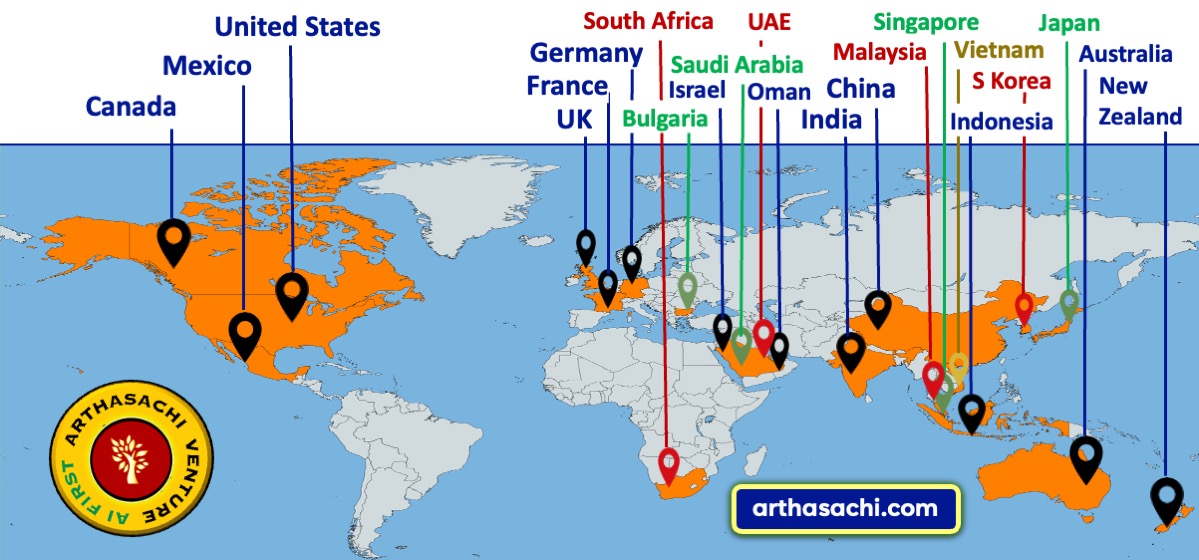
Arthasachi Venture Footprints
Apps
Dowload Our "Arthasachi Venture Wealth" Apps
Apple IOS App

Andriod App